
What is a P60? Guide to understand p60
What Is a P60?
P60 is end of the Tax Year Certificate. If you work in the UK, your P60 is one of the most useful and important documents you’ll receive each year as an employee. It arrives after the tax year ends and pulls together everything HMRC needs to know about your earnings and the tax you’ve paid. Yet most people file it away without really understanding what is a P60, until they need it for something important.
Whether you are getting married, applying for a mortgage, or double-checking your tax bill, are an employer or an employee, understanding your P60 will avoid the complications and stress that come with being underpaid/having overpaid income tax for a tax year.
If you lost or did not receive your p60, then you can have a your genuine p60 replaced within 2 hours from PayslipsP60.co.uk.
What information is printed on a P60?
A P60, officially called an End of Year Certificate, summarises your income and deductions for the year (6 April to 5 April) as an employee. Employers must issue it by 31 May. In simple terms, it confirms:
- How much did you earn as an employee
- Is your tax paid for the tax year
- Your National Insurance contributions
- Any statutory payments
- Your pension contributions for the tax year
- Whether your tax code was correct
Think of it as your annual earnings and financial snapshot, the “proof” many organisations rely on to confirm your income and tax paid for a tax year as an employee.
For Example:
If you’re applying for a mortgage, lenders usually ask for your most recent P60. Getting a P60 as an employee gives them a reliable picture of the earnings produced directly from payroll, not something you typed in yourself.
Who Gets a P60?
Not everyone gets a P60, and that’s where people often get confused.
Employees: If you’re employed on 5 April, you will receive a P60 form for that job. If you hold multiple jobs, you’ll get one from each employer.
Company Directors of a Limited Company: If you take a salary from your own limited company, you must issue yourself a P60 form through your payroll software, acting on behalf of an employer.
Umbrella Company Workers: Your umbrella company, not the end client, issues the P60 form.
Pension Recipients: If tax is deducted from your pension, your pension provider must give you a P60 form. It is legally required.
Self Employed having Multiple Jobs or Having More than One Job:
Self employed individuals do not receive a P60 form. Instead, they use an SA302 as proof of earnings.
If You’ve Left a Job:
Left before 5 April? You’ll receive a P45, not a P60, from your former employer. Your new employer’s P60 will only include earlier earnings if you handed in your P45.
If you lost or did not receive your p60, then you can have a your genuine p60 replaced within 2 hours from PayslipsP60.co.uk.
What Your P60 Shows (And Why It Matters)
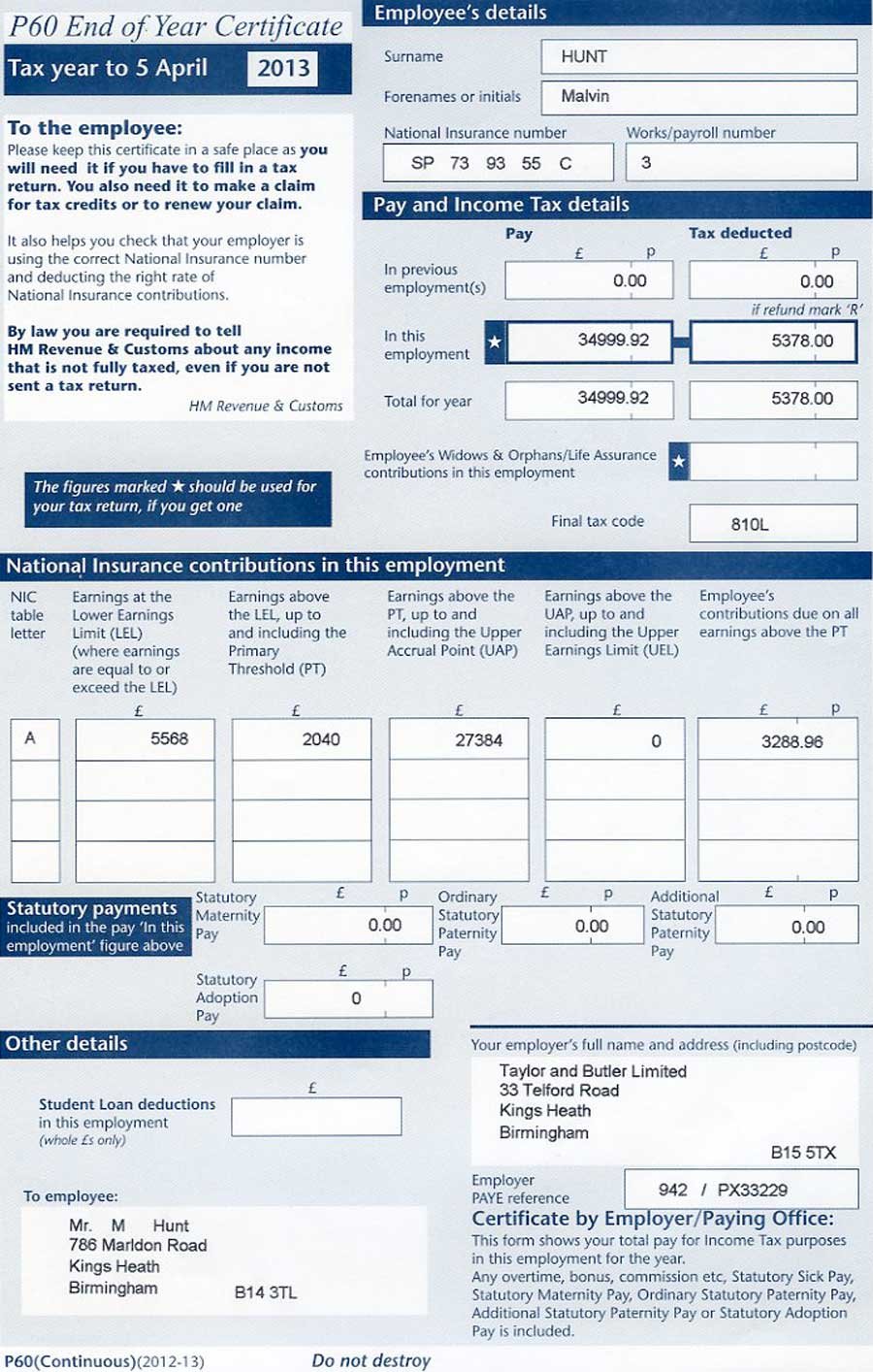
A P60 includes the core key information HMRC needs to confirm whether you’ve paid the right amount of tax deductions.
Here’s what you’ll typically find:
Your Personal Details: Name, national insurance number, and payroll number.
Employer Information: Name, address, and PAYE reference.
and following Income Details:
- Total pay for the previous year
- Income tax deducted
- National Insurance contributions
- Student loan repayments
- Pension contributions
- Any statutory payments (like maternity pay or statutory sick pay)
If you changed jobs and submitted your P45, your P60 will combine the figures for tax details. If you didn’t, the earlier earnings won’t appear.
Why Your P60 Is an Important Document
Most people only look for their P60 when they need it urgently, often for a mortgage or loan application. But it serves several other important purposes.
Check if You’ve Paid the Right Tax Year
If your tax code was wrong, you may have paid too much tax deducted or too little tax. Your P60 is your friend in spotting this quickly.
Claim Tax Rebate
You need a P60 to claim any tax rebate or just confirm if HMRC owes you money.
Support a Self Assessment
If you complete an Assessment, your P60 provides the exact figures you need for your.
End of the tax return
Apply for Certain Benefits or Tax Credits, It acts as proof of your earnings for government applications. In short, it’s a document worth keeping safe, ideally for at least four to six years.
How to Read and Understand Your P60
Your P60 isn’t as complicated as it looks once you know where to focus.
Start with Personal Information
Please ensure that the name, NI number, and payroll number are correct. Mistakes here can lead to problems with HMRC’s regulations at the end of the tax year.
Check Your Tax Code
Your tax code determines your tax-free allowance. If it’s wrong, your tax will be wrong.
Look for Additional Deductions
This includes student loan repayments and state pension contributions. Mistakes in these areas are more common than you might think.
For Example
If your student loan deductions seem unusually high, your P60 helps you challenge it with payroll or HMRC at the end of the tax year.
How to Get a P60
You do not apply for a P60; it is provided to you by your employer, but If you have lost it or did not receive your P45, and you can not get a copy from your employer, then you can have a your genuine p60 replaced within 2 hours from PayslipsP60.co.uk.
HMRC doesn’t send replacements, but you can view your tax history online.
If Your P60 Form Document Is Missing or has Wrong Details or If you haven’t received your P60 by the end of May, get in touch with your employer’s payroll department. It’s their responsibility to issue it.
Incorrect P60
Report errors immediately. Payroll can amend and issue a corrected version.
Lost P60
Your employer maybe able to reissue you with coy, or contact PayslipsP60.co.uk for a FREE advice on how to get your p60.
Employers have to:
- Give every employee a P60 by 31 May
- Include accurate information for PAYE and tax information
- Issue a P45 when someone leaves
- Use compliant payroll software or HMRC’s Basic PAYE Tools
- Failure to issue P60s can lead to compliance issues and frustrated employees.
How Your P60 Form Document Links to Your Tax Calculations
Your P60 helps you understand:
- How much tax you paid as an employee (whether salaried from an employer or self employed)
- Whether your code on salary from the employer was the correct amount
- If you’re due a tax refund
- How much you contributed to pensions and paid National Insurance
It’s also a helpful reference when comparing previous financial years’ earnings or checking that payroll handled everything correctly for that given tax year.
Conclusion
Your P60 isn’t just an end-of-year form; it’s your financial statement for the year. Knowing it saves you from overpaying tax, deductions, makes financial applications much easier, manages tax returns, and keeps your records with HMRC accurate. Keep it safe, look it over carefully, and use it to your advantage whether you are an employee, an employer, or self employed.
Frequently Asked Questions
Is a P60 the same as a P45?
No. A P45 shows earnings up to your leaving date from an employer. A P60 summarises
your full year as an employee. Hence, both are entirely different in their scope and application.
Can a P60 be used as proof of income?
yes with the p60 you can proof your income for a mortgage, loan, finance, immigration visa.
England: Bath, Birmingham, Bradford, Brighton, Bristol, Cambridge, Canterbury, Carlisle, Chelmsford, Chester, Chichester, Colchester, Coventry, Derby, Doncaster, Durham, Ely, Exeter, Gloucester, Hereford, Hove, Kingston upon Hull, Lancaster, Leeds, Leicester, Lichfield, Lincoln, Liverpool, London, Manchester, Milton Keynes, Newcastle upon Tyne, Norwich, Nottingham, Oxford, Peterborough, Plymouth, Portsmouth, Preston, Ripon, Salford, Salisbury, Sheffield, Southampton, Southend-on-Sea, St Albans, Stoke-on-Trent, Sunderland, Truro, Wakefield, Wells, Westminster, Winchester, Wolverhampton, Worcester, York. Scotland: Aberdeen, Dundee, Dunfermline, Edinburgh, Glasgow, Inverness, Perth, Stirling. Wales: Bangor, Cardiff, Newport, St Asaph, St Davids, Swansea, Wrexham. Northern: Ireland, Armagh, Bangor, Belfast, Lisburn, Londonderry (Derry), Newry